 English (UK)
 Ελληνικά
- Details
- Written by: Eglantine Bautru-Valois
- Category: Volunteer Blog
- Hits: 312
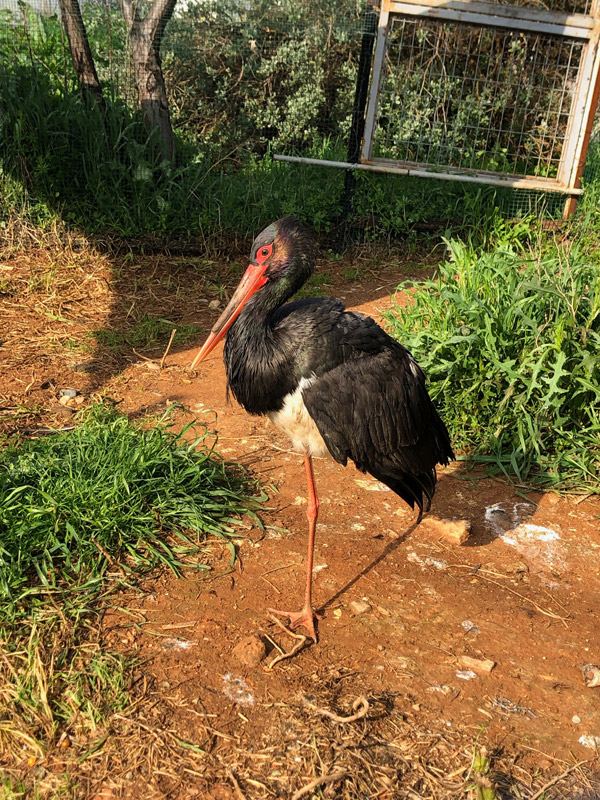
The day I arrived at Drasi, I was amazed by the number of storks I saw. We have many in the outside cages, but also daily visitors who, to be honest, only come back for the food. But what I saw was also a black stork. I didn’t even know this species ! And it is very different from its close cousin. Let me explain.
This species has a black plumage with white underparts, and a red circle around the eye. In the sun, you can see green, purple and yellow reflexions on its feathers. The males are identical to females, except for the size (they are bigger). This long-distance migrant crosses Europe to reach India or Africa. If its area of distribution goes from Spain to China, and even Africa, it is nowhere abundant. It is a quite uncommon species.
Unlike the white stork, they are really shy, wary and solitary. You can only see them alone or in pairs. During migrations, they travel in groups of less than 100 individuals. The one we have at Drasi is missing a part of the wing. Which means that she won’t be able to fly ever again. But because she has such a special behavior, she lives alone in an outside cage. If we one day receive another black stork, the one we have now will help its release by showing it how to feed itself and more.
- Details
- Written by: Eglantine Bautru-Valois
- Category: Volunteer Blog
- Hits: 333
Spring is here ! Which means that we’ll receive more babies here in Drasi ! If they are astonishingly cute, they need a lot of attention. In the wild, the feeding process is done by the parents. So until they can eat by themselves, we have to replace them.
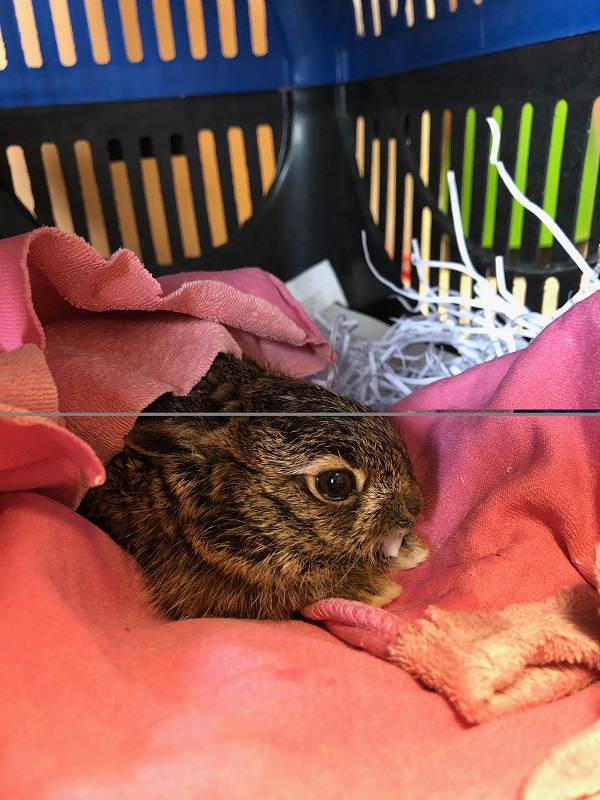
I’ll tell you about my recent experience concerning a baby hare. He must be a few weeks old now, but he still needs a lot of attention. 4 times a day, I feed him with a syringe of goat milk, full of good fats. It’s quite tricky, because he often won’t cooperate. Patience is key ! But to me, it’s amazing to see how they are first on the lookout, and then start trusting you and accept the food. We also give him access to dried corn and herbs, and some fresh leaves.
Let’s talk a bit more about hares. Larger than rabbits, they live in simple nests above the ground, and usually live alone or in pairs. Unlike rabbits, hares are born with fur and open eyes, which provide them a protection their habitat doesn’t. They are very fast mammals, because they can run up to 80 km/h, and even jump up to 2 meters high !
Unfortunately, the hare population has decreased a lot over the past decades. The major cause is the fragmentation of their territory, because they are scared about crossing roads. In this way, they tend less towards car accidents, but more towards consanguinity.
- Details
- Written by: Maylis Begue
- Category: Volunteer Blog
- Hits: 431
I was in biologie bachelor degree in France at Angers, I wanted to be ethologist and doing a master after,but a lot of things change.
First of all, my first year at the university wasn’t very good ( my grade were bad), so i decided to dotwointernshipsto enrich my file, I went to a rescue center in the south of France for turtles! I was so excited and it was a very good experience and afetr this one I also went to another rescue center for farming animalsin Belgium, very enrich also. I spend 1 month on each. And I pass my first year.
After this 2 internships, I was sure to work with animals,but I wanted to keep going with university. Unfortunately, it was a disaster, for me it was very complicated, I don’t like to learn without practise. I think it’s more easy, my brain learn betterthat way.
- Details
- Written by: Eglantine Bautru-Valois
- Category: Volunteer Blog
- Hits: 402
Carnet de route Franco-Luxembourgeois pour un voyage de 3 jours à Athènes
[for English see below French...]
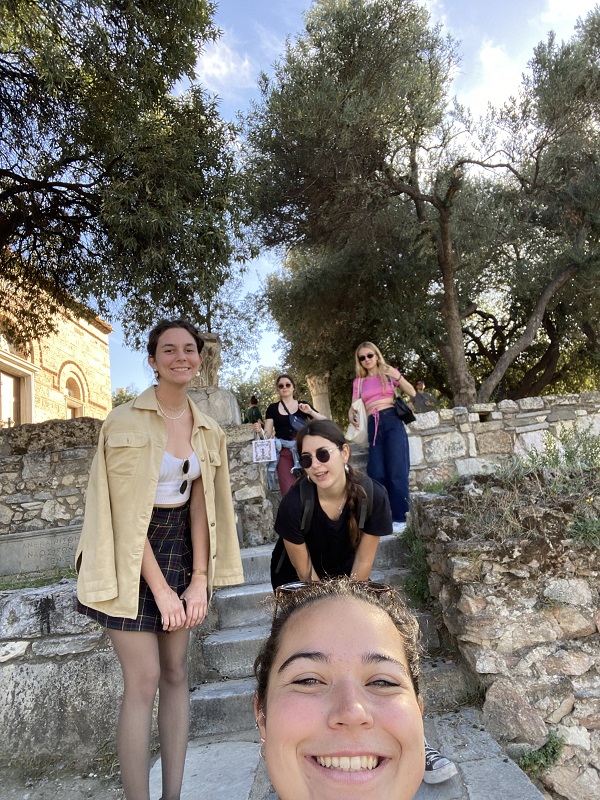
Nous sommes parties le 17 novembre au soir, à bord du train Thessalonique-Athènes, pour rejoindre la capitale grecque. Après un voyage de plus de 4h, nous atteignons notre Airbnb, en plein centre de la ville. Une petite nuit de sommeil plus tard, nous partons en direction de l’Acropole. Sous un grand soleil, nous découvrons ce patrimoine culturel impressionnant. Le Parthénon fait parti de ces monuments incontournables. Malgré sa renommé, on ne peut être déçu.e en le découvrant. Si vous voulez en savoir plus sur son histoire, vous pouvez regarder cette vidéo sur Arte : (cliquer)
Les théâtres et temples qui l’entourent sont tout aussi impressionnants, sans parler de la vue sur la ville. Bientôt 15h, nous allons manger dans une taverne non loin d’ici. Puis nous passons par un magasin de thé grec, proposant aussi d’autres spécialités régionales. Nous ne pouvions pas résister à ces odeurs riches et alléchantes... Nous avons ensuite déambulé dans la ville, notamment vers Plaka. Bien que ce soit très (un peu trop peut-être) touristique, l’ambiance est très joyeuse. Nous allons ensuite visiter le musée de l’Acropole, qui tous les vendredis propose des nocturnes jusqu’à 22h. En plus de pouvoir profiter du musée de nuit, nous sommes presque seules dans le bâtiment. Et quelle vue sur l’Acropole ! Plus tard, nous trouvons un bar-restaurant où nous poser, avec de la musique grecque en live. Soirée réussie !
- Details
- Written by: Eva Kass
- Category: Volunteer Blog
- Hits: 534
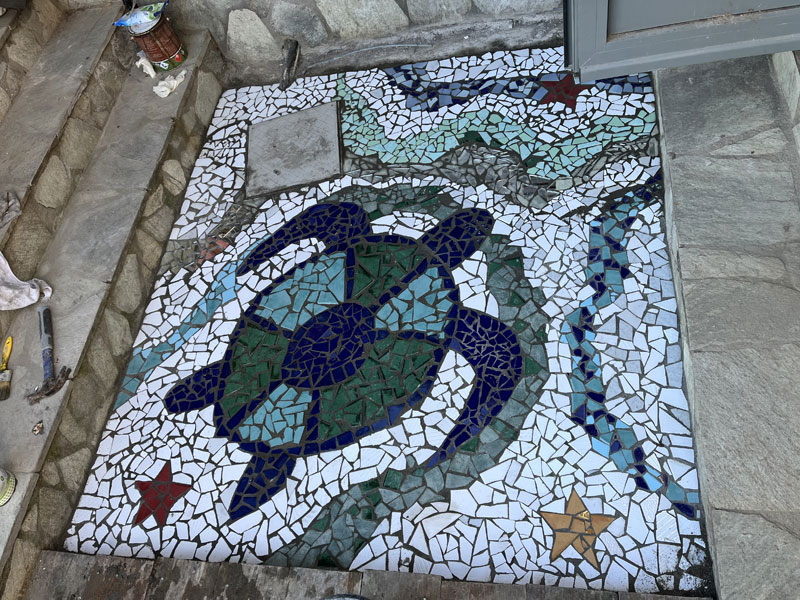
While going on walks through the Axios National Park I noticed dumps of bathroom renovation debris lying around. Here and there on these dumps colourful bathroom tiles sparkled. I felt it would be a waste to just let them rot there seeing as they were still intact. I started to collect them on my walks and carry them back to Drasi.
Earlier in the day at Drasi I had tried to tidy up the front space a bit, which is akin to a Sisyphus task but that never stops anyone from trying. The rectangular space underneath the volunteer’s entrance in all its messiness and unevenness bothered me a bit and I felt it should be beautified. Perfect for a Mosaic!
After getting the approval of Sophia, Froso, Penelope and Anastasia and excavating the site to a deptht of around 15cm the project stagnated a bit. The tiles had to wait in their boxes and watch us go about our work or carry our suitcases early in the morning to the cars waiting to take us on our adventures to Olympos, Athens or elsewhere. They were also witness to Thomas, who had freshly returned from one of his voyages and didn’t yet know about the hole, tripping and scraping open his leg. But where would we be without a bit of human sacrifice?